
Parasaurolophus Coloring Pages
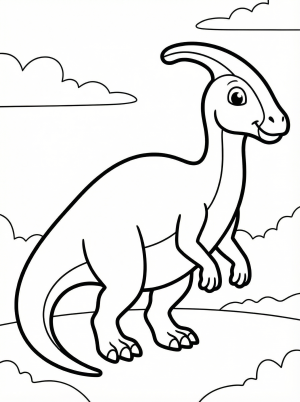
Step into the fascinating world of the Parasaurolophus with our expertly designed coloring pages. These captivating printables offer more than just artistic expression; they provide a gateway to understanding prehistoric life and developing crucial skills. Transform screen time into a valuable educational adventure with our premium resources.
Discover more Dinosaurs themes
Continue your creative journey with these other popular collections within the Dinosaurs archive.
Educator's Guide to Parasaurolophus Coloring Pages
The Educational Power of Parasaurolophus
Engaging with Parasaurolophus coloring pages provides a rich educational experience, fostering both artistic talent and scientific curiosity. This remarkable dinosaur, whose name translates to 'near crested lizard,' is instantly recognizable by its distinctive, elongated crest extending from the back of its skull. This unique anatomical feature immediately captivates young minds, prompting questions about its purpose and function. Learning about the Parasaurolophus introduces children to the concept of paleontological discovery and the incredible diversity of life that once roamed Earth millions of years ago.
Scientifically, the Parasaurolophus offers an intriguing case study. Experts believe its hollow crest may have functioned as a resonating chamber, allowing the dinosaur to produce distinct calls for communication, perhaps to warn others of predators, attract mates, or identify itself within its herd. Furthermore, the crest could have served as a visual display, signifying age or status. As a herbivore, Parasaurolophus roamed ancient forests, likely feeding on leaves and twigs. Exploring these facts through coloring helps children develop a foundational understanding of ecosystems, food chains, and adaptations.
Beyond basic facts, the act of coloring the Parasaurolophus enhances cognitive development. It encourages children to pay close attention to details like its skin texture, body shape, and the structure of its crest, thereby improving observational skills. It also expands vocabulary as children learn terms such as 'herbivore,' 'cretaceous period,' 'hadrosaur,' and 'paleontologist.' This active engagement transforms passive learning into a hands on exploratory journey, deepening their appreciation for science and natural history while promoting imaginative play and critical thinking.
Classroom & Home Learning Ideas
These Parasaurolophus coloring pages offer numerous avenues for educational enrichment beyond simple artistic expression. One creative approach for teachers and parents is to encourage children to design the dinosaur's habitat. After coloring the Parasaurolophus, children can draw or paste elements of its environment, such as prehistoric trees, water bodies, or other contemporary dinosaurs, fostering an understanding of ecosystems and natural settings.
Another engaging activity involves exploring the dinosaur's potential sounds. Given the unique structure of its crest, children can be invited to imagine and recreate the low frequency calls a Parasaurolophus might have made. This imaginative exercise stimulates auditory processing and creative thinking, allowing them to connect anatomical features with functional possibilities.
Furthermore, these sheets can serve as powerful prompts for storytelling and creative writing. Children can invent narratives about a Parasaurolophus's day, detailing its adventures, interactions with other dinosaurs, or challenges it faced in its ancient world. This practice significantly boosts language development, narrative structure comprehension, and imaginative faculties, allowing for rich literary expression.
Finally, the coloring pages can facilitate a comparative anatomy lesson. Children can color various hadrosaurs or other dinosaurs and then discuss the similarities and differences in their body structures, focusing on unique features like the Parasaurolophus's crest. This encourages analytical thought and a deeper scientific understanding of classification and evolutionary adaptations within the dinosaur kingdom.
Artistic Development
Coloring a Parasaurolophus provides excellent opportunities to refine artistic skills. To give the dinosaur a sense of realism and dimension, artists can experiment with shading. Applying darker colors to areas that would naturally be in shadow, such as under the belly, beneath the crest, or on the far side of its limbs, while using lighter shades for areas hit by an imaginary light source, creates a convincing three dimensional effect.
Considering the texture of the dinosaur's skin is also crucial for an authentic depiction. Using small, overlapping strokes can suggest scales or a leathery hide, rather than a smooth, flat surface. Varying the pressure applied to coloring tools can also create different textures, adding depth and visual interest to the illustration. Children can be encouraged to think about how different parts of the dinosaur might feel.
Furthermore, thoughtful color choices can significantly enhance the artwork. While naturalistic greens, browns, and grays are common for dinosaurs, encouraging children to explore a wider palette, perhaps even fantastical colors, can foster imaginative expression. Adding background elements, such as ancient foliage or a prehistoric sky, not only completes the scene but also helps to place the Parasaurolophus within its historical context, making the artwork more dynamic and engaging. Experimentation with crayons, colored pencils, and markers each offers unique effects, broadening a child's artistic repertoire.
Expert Teaching Tips
- 1Discuss the Parasaurolophus's unique crest: Ask children what they think its purpose was for communication or display.
- 2Encourage sound imitation: Challenge kids to imagine and create the low frequency sounds this dinosaur might have produced.
- 3Research its ancient habitat: Prompt children to discover what plants Parasaurolophus ate and what other animals lived alongside it.
- 4Compare sizes: Use a measuring tape to show the real world scale of a Parasaurolophus, helping visualize its immense size.
- 5Utilize varied materials: Encourage using different art supplies like paints or pastels to explore unique textures and color blending.
Our Quality Commitment
We personally print and test every parasaurolophus design. We guarantee crisp, bold lines optimized for 8.5" x 11" paper.
Frequently Asked Questions
What made the Parasaurolophus unique among dinosaurs?
The Parasaurolophus was primarily unique due to its large, elongated, hollow crest extending backward from its skull. This striking feature is believed to have played a crucial role in communication, allowing the dinosaur to produce distinctive calls through its resonating chambers. It may have also served as a visual display, signaling maturity or status within its herd, making it one of the most recognizable and fascinating hadrosaurs of the Late Cretaceous period.
How do Parasaurolophus coloring pages support child development?
Parasaurolophus coloring pages offer a multitude of developmental benefits. They significantly enhance fine motor skills and hand eye coordination as children learn to control their coloring tools within defined lines. Creativity and imaginative thinking are sparked through color choices and envisioning the dinosaur's prehistoric world. Cognitively, children develop focus, concentration, and patience. Furthermore, these pages introduce scientific concepts, expand vocabulary related to paleontology, and foster a lifelong curiosity about natural history and prehistoric life.