
Hot Dogs Coloring Pages
Delight young learners with our engaging collection of hot dog coloring pages, transforming a familiar treat into a powerful educational tool. These carefully crafted printables offer more than just creative fun; they provide a rich foundation for exploring food culture, promoting artistic development, and enhancing essential motor skills in an appealing way.
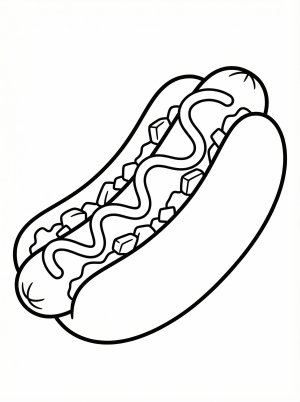



Educator's Guide to Hot Dogs Coloring Pages
The Educational Power of Hot Dogs Hot dogs, a quintessential part of many cultural experiences, offer surprisingly rich avenues for educational exploration beyond mere entertainment. Children can embark on a journey exploring the diverse origins of this global food, from its historical roots in Frankfurt, Germany, to its widespread adoption and adaptation across America and the world. Discussing the basic ingredients involved, such as various meats and seasonings, can introduce fundamental concepts of food composition and preparation in a simplified manner suitable for young minds. This process encourages observation skills as children identify different parts of the hot dog and its bun, fostering vocabulary development as they learn terms like 'frankfurter,' 'wiener,' 'bun,' 'ketchup,' and 'mustard.' Furthermore, these coloring activities can spark conversations about food groups and balanced eating, even if the hot dog itself is enjoyed in moderation, positioning it as an entry point for broader nutritional discussions.
Classroom & Home Learning Ideas These hot dog coloring pages serve as excellent springboards for a variety of interactive learning activities in both classroom and home environments, extending far beyond simple artistic expression. One creative approach involves using the hot dog as a geographical marker; children can research and discuss where hot dogs are most popular around the world, perhaps drawing lines on a world map or coloring the flags of countries known for their hot dog variations. Teachers might also consider integrating science lessons by exploring how hot dogs are made or preserved, discussing the concepts of heat and refrigeration, or even experimenting with making simple, kid friendly toppings from garden vegetables. For developing mathematical thinking, children can count the number of hot dogs on a page, estimate how many toppings could fit on each, or compare the lengths of different hot dog illustrations. Furthermore, these pages can inspire language arts activities where children invent stories about a bustling hot dog stand, write descriptive sentences about their favorite toppings, or even create a simple menu featuring various hot dog combinations, thus enhancing their narrative and descriptive writing abilities.
Artistic Development Engaging with hot dog coloring pages presents unique opportunities for children to refine their artistic skills and explore advanced coloring techniques. Encourage children to observe real hot dogs and their accompaniments to understand the subtle variations in color and texture. For instance, achieving the distinct reddish brown hue of a cooked hot dog might involve blending different shades of brown and orange, while the bun could utilize softer yellows and light browns to suggest its bready texture. Children can experiment with depicting the shiny, smooth appearance of ketchup versus the slightly thicker, grainier texture of mustard by varying their coloring pressure and even using different mediums if available. Introducing the concept of layering colors can add depth and dimension to their artwork; for example, coloring the hot dog first, then carefully adding the bun, and finally placing the toppings. Furthermore, discussing how light interacts with objects can lead to simple explorations of shadowing, where adding a slightly darker shade on one side of the hot dog or bun can make it appear more three dimensional and lifelike, elevating their artistic interpretation.
Expert Teaching Tips
- 1Discuss the origins and cultural significance of hot dogs while coloring, expanding geographical knowledge.
- 2Encourage children to use descriptive words for colors and textures found on their hot dog creations.
- 3Challenge them to draw additional toppings or backgrounds, fostering imaginative storytelling.
- 4Explore color blending techniques to achieve realistic shades for the hot dog, bun, and various condiments.
- 5Turn it into a mini science lesson by discussing basic ingredients and how foods are prepared.
Our Quality Commitment
We personally print and test every hot dogs design. We guarantee crisp, bold lines optimized for 8.5" x 11" paper.
Frequently Asked Questions
Are hot dog coloring pages appropriate for young children?
Absolutely, hot dog coloring pages are wonderfully appropriate for young children. They feature a recognizable and often beloved food item, making the activity highly engaging. This familiarity encourages sustained focus, helps develop fine motor skills, improves hand eye coordination, and provides a gentle introduction to cultural foods in a fun, accessible format.
How do these help with development?
These coloring pages significantly aid in a child's developmental journey by strengthening fine motor skills and grip through holding and manipulating crayons or pencils. They enhance hand eye coordination as children carefully color within lines. Furthermore, they promote color recognition and artistic expression, while simultaneously opening doors for discussions about food culture, basic nutrition, and the imaginative exploration of real world objects.