
Candy Coloring
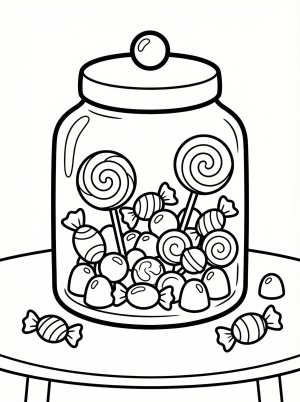
Step into a world of sweet imagination with our captivating collection of candy coloring pages. These delightful printables offer much more than just artistic enjoyment; they serve as a unique gateway to foundational learning and creative expression for young minds. Dive into a treasure trove where education meets vibrant fun, designed to inspire and engage children of all ages.
Discover more Food themes
Continue your creative journey with these other popular collections within the Food archive.


Educator's Guide to Candy Coloring Pages
The Educational Power of Candy Coloring Pages Candy, in its myriad forms, offers a surprisingly rich tapestry for educational exploration, extending far beyond a simple treat. Engaging with candy themed coloring pages allows children to delve into fundamental concepts such as color theory, where they can experiment with different hues to represent flavors or textures, developing a deeper understanding of visual aesthetics. Furthermore, these pages encourage pattern recognition as children observe and replicate the intricate designs on wrappers or the distinct shapes of various confections, honing their observational skills. Discussions about different types of candies can naturally lead to geographical or cultural learning, exploring how certain sweets are unique to specific regions or traditions across the globe. Moreover, the act of coloring provides an excellent opportunity to introduce basic mathematical concepts; children can count individual candies, sort them by imagined flavor or color, or even begin to understand simple fractions by discussing portions of a candy bar, all within an enjoyable context. This creative engagement also opens avenues for conversations about balanced nutrition and making healthy choices, using the candy imagery as a relatable starting point for broader discussions about food groups and moderation.
Classroom & Home Learning Ideas Transforming candy coloring sheets into dynamic learning tools requires a creative approach for both educators and parents. One engaging activity involves using the colored candies as visual aids for science experiments; children could research how different candies are made or even perform simple experiments at home, such as dissolving various sweets in water, then illustrating their observations on the coloring page itself. For literacy development, encourage children to invent a backstory for their candy, perhaps writing a short descriptive paragraph about its magical flavors or who might enjoy eating it, thereby integrating imaginative writing with visual art. Furthermore, teachers might consider a sorting and graphing activity where children color different categories of candies, then use tally marks or draw simple bar graphs to represent the quantities of each, reinforcing early mathematical concepts in a playful manner. An innovative art project could involve children designing their own candy wrappers or creating a new candy product based on the template, stimulating their entrepreneurial thinking and artistic creativity while exploring branding elements. These activities transition the coloring experience from a passive pastime into an active, multidisciplinary learning adventure.
Artistic Development Beyond simply filling in spaces, candy coloring pages present wonderful opportunities to cultivate advanced artistic skills. Children can learn about varying degrees of pressure to achieve different shades and intensities of color, understanding how to make certain elements appear lighter or darker to create depth. Exploring blending techniques becomes particularly relevant with candy imagery, as they might try to smooth colors together to represent glossy surfaces like hard candy or the soft transitions of a lollipop swirl, enhancing their perception of light and shadow. Staying within the lines, while seemingly basic, significantly refines fine motor control and hand eye coordination, skills crucial for writing and other detailed tasks. Furthermore, children can be encouraged to think about texture representation; how might they make a chocolate bar look rich and smooth, or a gummy candy appear soft and chewy, using only colors and lines? This exercise in visual problem solving promotes a more thoughtful and deliberate approach to art, moving beyond mere replication to interpretive artistic expression.
Coloring Tips & Techniques
- 1Encourage imaginative storytelling; ask children to describe the taste or origin of their colored candy.
- 2Discuss color mixing and shading techniques to give candies realistic depth and shine.
- 3Integrate basic counting or sorting activities based on the candy types on the page.
- 4Explore the cultural significance of certain candies, linking art to global awareness.
- 5Focus on fine motor skill development by encouraging careful, deliberate coloring within boundaries.
Our Quality Guarantee to Educators
We believe classroom resources should be high-quality and stress-free. Every worksheet on WorksheetSource is personally printed and tested by our team to ensure it fits standard 8.5" x 11" paper with clean, sharp outlines.
Frequently Asked Questions
Are candy coloring pages appropriate for all ages and learning stages?
Yes, candy coloring pages are remarkably versatile and adaptable across various age groups. For younger children, they are excellent for developing basic color recognition and fine motor skills. Older children can use them to explore more complex shading techniques, design principles, or even as a springboard for creative writing and cultural discussions about candies from around the world. Parents and educators can tailor the learning objectives to suit the child's developmental stage, making these pages a valuable resource for everyone.
How do these help with development?
Candy coloring pages significantly aid development in multiple key areas. They enhance fine motor skills and hand eye coordination as children carefully manipulate coloring tools and work within defined spaces. Cognitively, they stimulate creativity, imagination, and problem solving, especially when children experiment with color combinations or design new elements. Emotionally, the focused activity provides a calming and engaging outlet for self expression, building concentration and attention spans. Furthermore, they can initiate discussions about colors, shapes, patterns, and even cultural topics, fostering vocabulary expansion and general knowledge.
Candy Coloring in English