
Sunflowers Coloring
Step into a vibrant world of learning and creativity with our exquisite collection of sunflower coloring pages. Each meticulously designed sheet offers more than just artistic expression; it's a gateway to discovering the wonders of nature and developing essential skills. Immerse your students or children in an engaging educational experience that blossoms with every stroke of color.
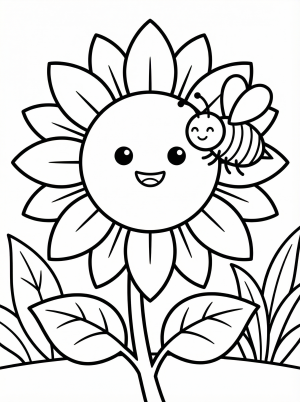
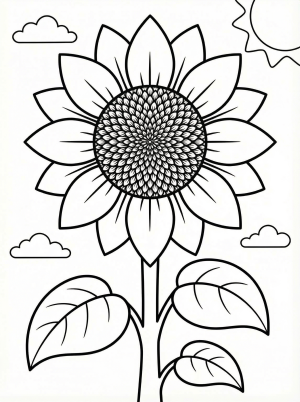


Educator's Guide to Sunflowers Coloring Pages
The Educational Power of Sunflowers
Sunflowers are truly remarkable plants, captivating observers with their impressive height, brilliant yellow petals, and fascinating life cycle, offering a rich source of educational exploration. From a botanical perspective, they exhibit a phenomenon known as heliotropism, where the young flower heads track the sun across the sky throughout the day, an incredible adaptation that can spark immense scientific curiosity in children. Furthermore, their large seed heads, often displaying intricate spiral patterns based on the Fibonacci sequence, provide a natural introduction to mathematics and geometry. Engaging with sunflower themed materials can enhance a child's understanding of plant anatomy, agricultural processes, and the importance of pollinators in our ecosystem. The act of coloring itself fosters crucial developmental milestones, including the refinement of fine motor skills, improvement of hand eye coordination, and the strengthening of concentration, all while encouraging imaginative play and a deeper connection to the natural world around us. Sunflowers also symbolize happiness and longevity in many cultures, adding a layer of cultural appreciation and positive association to the learning experience.
Classroom & Home Learning Ideas
These sunflower coloring pages offer a versatile foundation for a wide array of educational activities, extending well beyond simple artistic expression. Teachers might introduce these pages as a springboard for scientific exploration, particularly when discussing heliotropism, the plant's remarkable life cycle, or the structure of its seeds. Furthermore, these sheets can serve as an engaging tool for mathematical discovery, allowing children to count petals, estimate height comparisons, or explore the spiral patterns found in sunflower seed arrangements. Integrating the coloring activity with a brief study of artists like Vincent van Gogh, who famously depicted sunflowers, enriches an art history lesson, introducing impressionism through a familiar and beloved motif. Finally, encouraging students to write a short poem, a descriptive paragraph, or a creative story inspired by their colored sunflower transforms the activity into a valuable language arts exercise, promoting literacy and imaginative thinking.
Artistic Development
Developing artistic skill often involves experimenting with various hues of yellow and orange to capture the radiant quality of sunflower petals, perhaps even blending colors directly on the page for a more vibrant and lifelike effect. Understanding how light interacts with the flower allows for effective shading, adding depth and dimension to the petals and the central seed head, making the image appear more three dimensional. Close attention to the intricate arrangement of the seeds and the subtle textures of the petals provides an excellent opportunity for detailed work, enhancing observational skills and encouraging patience. Moreover, considering a simple background, such as a clear blue sky, a gentle gradient of green fields, or a few complementary leaves, helps to complete the composition, framing the sunflower as the central focal point of the artwork and encouraging an understanding of basic compositional principles.
Coloring Tips & Techniques
- 1Encourage observation: Before coloring, look at real or photographic sunflowers to discuss their parts and colors.
- 2Discuss color theory: Introduce warm colors (yellow, orange, brown) and how they make the sunflower feel vibrant.
- 3Integrate counting: Count petals or sections of seeds to blend math with art.
- 4Prompt storytelling: Ask children to imagine where their sunflower grows or what its day is like.
- 5Showcase artwork: Display finished pages to celebrate effort and foster pride in their creations.
Our Quality Guarantee to Educators
We believe classroom resources should be high-quality and stress-free. Every worksheet on WorksheetSource is personally printed and tested by our team to ensure it fits standard 8.5" x 11" paper with clean, sharp outlines.
Frequently Asked Questions
What are some fun facts about sunflowers that kids will love to learn?
Kids are fascinated to learn that young sunflowers actually follow the sun across the sky throughout the day, a process called heliotropism, before they eventually settle facing east as they mature. They can grow incredibly tall, some varieties reaching over ten feet, and their large heads are not just one flower but hundreds, even thousands, of tiny flowers that produce delicious seeds. These seeds are a popular snack and are also pressed to make cooking oil, showcasing the plant's versatility and importance.
How do these sunflower coloring pages contribute to a child's overall development?
Engaging with sunflower coloring pages offers numerous developmental benefits. They significantly improve fine motor skills and hand eye coordination as children learn to grip coloring tools and stay within lines. Furthermore, these activities boost creativity, color recognition, and self expression. The sustained focus required for coloring helps to lengthen attention spans, while the beauty of the sunflower fosters an early appreciation for nature and can spark curiosity about science and botany.
Sunflowers Coloring in English